

Try the #1 software for $1/month.
Norem ipsum dolor sit amet, consectetur adipiscing elit. Etiam eu turpis molestie, dictum est a, mattis tellus. Sed dignissim, metus nec accumsan.

Fitness Business Marketing

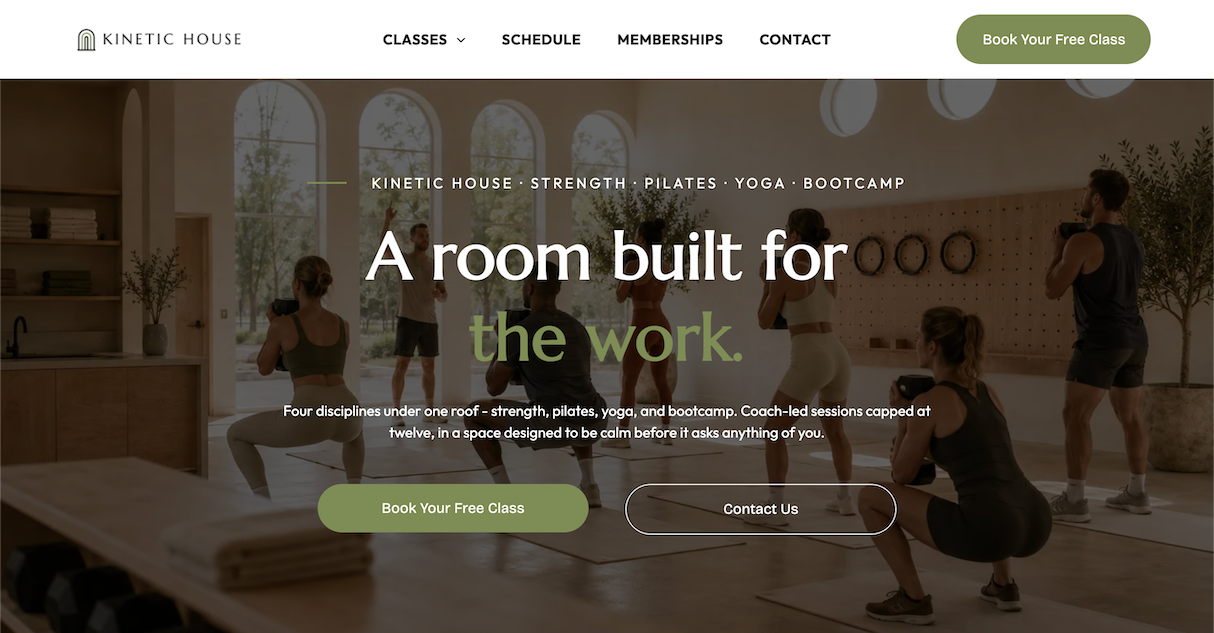
When you first opened your business, you might have given your gym website a lot of time and energy. After all, it’s the online version of the physical space you took so much care in building. But since you opened your doors, when was the last time you updated your website?
From fresh, helpful content to the search engine optimization (SEO) value it holds, your gym website has the potential to be the most high-performing part of your marketing strategy. It might be their first and only impression about your business. Which means the pressure is high to get them to book an intro before they continue scrolling.
Great news! It’s not complicated, even if you update it on your own. And if you want some help, we’ve got your back there as well. Let’s take a look at what your website should look like in 2026.
When someone is interested in checking out your fitness business, they should be able to schedule an intro session or first class within a click or two. It’s pretty simple: people expect to see your schedule, pick a time, and reserve a spot without leaving your site, downloading a PDF, or (gasp) having to call you.
A few things to check on your gym website right now:
If your booking flow sends people somewhere else entirely, that’s a context switch. And every extra click is a chance for someone to bail. Since Wodify is an all-in-one platform, scheduling tools embed directly into your site. So a lead can go from interested to booked seamlessly and quickly.
When it comes to transparent pricing on the website, most fitness business owners have some strong opinions. Some believe “contact us for pricing” on a gym website is a red flag. Others believe that transparency is how you filter out leads that aren’t serious.
No matter which camp you’re in, it’s important to have some reference to pricing on your gym website. The truth is, sometimes prospective clients don’t even know what they’re looking for when researching fitness options. Price might be the only thing they know how to compare. So acknowledge that, then decide how you prefer to present your pricing information.
Think about the way you’d search for a new restaurant to try. If the website was full of stock photography, you can’t see what the dining experience or the food actually look like. The same is true for your gym website. Generic fitness models in a random space don’t allow leads to see what the real experience is like in your fitness business. And probably undercuts trust the second someone notices it.

Instead, fill your site with photos and videos of your actual members doing accessible movements. Show coaches giving direction and find fun ways to showcase your community. These images will go further than any website copy. And they’ll have a significant impact on introducing online visitors to the experience they’ll actually get within your physical walls.
Just like in the restaurant example above, having reviews can go a long way in proving to others that this is a place they want to do business with. On the homepage of your gym website, embedding some Google Reviews can prove that you have the expertise and experience to help prospective clients.
You can also link to your social media channels, where social proof posts can build even more credibility. Clients sharing transformation stories or even just photos and images that give glimpses into the member experience can be powerful.
Not every person who visits your website is going to be ready to book today, and that’s okay. The goal isn’t to add more pressure. Intead, you simply want to make sure they don’t leave your site without providing their contact information. That way, you can follow up, adding them to your automated workflows for as long as it takes for them to become a member.
Whether it’s a special offer like a trial pass or a lead magnet like a downloadable guide, create an opt-in that’s compelling enough that they can’t turn it down. Consider throwing this somewhere on your homepage or designing a fun pop-up that appears just before they would leave your gym website.
An active, consistently-refreshed blog has always been helpful for your SEO, but the bar has moved. Now, Google and AI tools like ChatGPT favor content that answers a specific question that your target audience is asking. For example, they play is no longer posting a vague post on your gym website about “the benefits of fitness.” Instead, think about the questions your leads and clients are asking:
If someone in your city searches “what’s the best gym for beginners near me” and your blog post answers that question directly, your site is more likely to appear in the results. Don’t make it complicated. When writing blog posts, simply choose the topics people are asking and write in the way you’d answer.
When people Google in “Gym near me,” that’s a local search, and local searches are overwhelmingly a phone-in-hand behavior. Google data shows that 76% of people who run a “near me” search visit that business within a day. And 88% of people who do a local search on their smartphone visit a related store within the week. When you’re trying to reach prospective clients, your gym website has to be optimized for mobile to make that experience easy.

Further, if your site takes more than a few seconds to load on that phone, people simply won’t wait around. There are some quick and easy ways to improve page speed: Compress images, cut anything unnecessary, and test your site on an mobile phone.
Okay, we’ll admit it. Your Google Business Profile isn’t actually a part of your website, so we’ll call this a bonus. Optimizing your profile might also be the single highest-return thing you can update this month, even before your gym website. An active profile often shows up before your site when someone performs a local search.
With that in mind, here’s how you should optimize your Google Business Profile today:
Fitness business owners invest a solid amount of time and effort into their gym website when they’re first opening the business. And then it’s not uncommon for them to neglect it as they get busy with the hundreds of other tasks on their plates each day.
But remember, your website is one of the most powerful parts of your gym marketing strategy, and it’s worth the effort to keep it updated. The list above was designed to be an easy way to work through this process, and to update your Google Business Profile as well.
That way, the beginning of the customer journey is a breeze for leads, which lays the foundation for a community full of long-term, loyal members for years to come.
Pro Tip: Need help? We’ve got you! Get a custom-built, search engine-optimized gym website designed for conversions and fully integrated with Wodify Sites, so you can manage leads, schedules, membership sales and more—all in one place. Or book a demo with the Wodify team today to learn more!
—
More reading: Check out Gym Website Examples: The Best Fitness Websites to Inspire Your New Design
Norem ipsum dolor sit amet, consectetur adipiscing elit. Etiam eu turpis molestie, dictum est a, mattis tellus.
Already know which provider you want to select?
Click “Sign up Now” to lock in your choice and pick your start date. It’s quick and easy!
Looking for a bit more information or guidance? Click “Talk to Us” to arrange a call with us. We’ll help you find the perfect program tailored to your needs.
Norem ipsum dolor sit amet, consectetur adipiscing elit. Etiam eu turpis molestie, dictum est a, mattis tellus.
Norem ipsum dolor sit amet, consectetur adipiscing elit. Etiam eu turpis molestie, dictum est a, mattis tellus. Sed dignissim, metus nec accumsan.
Norem ipsum dolor sit amet, consectetur adipiscing elit. Etiam eu turpis molestie, dictum est a, mattis tellus. Sed dignissim, metus nec accumsan.
We’ll let you try Wodify for yourself and get a feel for what it can do for your business. A Wodify rep — a real person — will walk you through every feature.




"Wodify transformed how we run the gym. I now have more time to focus on growing my business and helping members thrive."Dana Bradley, Owner of Westside Fitness
Click “Talk to Us” to arrange a call so we can discuss the flexible access options that best fit your facility.
Click “Book a Demo” to learn more about how Wodify can help your business grow.
Your branded app is one conversation away. Click “Talk to Us” and our team will walk you through everything you need to get started.
Click “Book a Demo” to learn more about how Wodify can help your business grow.