

Try the #1 software for $1/month.
Norem ipsum dolor sit amet, consectetur adipiscing elit. Etiam eu turpis molestie, dictum est a, mattis tellus. Sed dignissim, metus nec accumsan.

Market Your Gym

You did not open your gym because you wanted to spend your nights searching “how to rank on Google.”
You opened it because you know how to coach. You know how to build trust. You know how to help someone walk in unsure and leave stronger, sharper, calmer, or more confident than they thought they could be.
But if someone nearby searches “CrossFit near me,” “adult Jiu-Jitsu classes,” “HIIT gym in [city],” “Pilates studio near me,” or “personal trainer in [neighborhood],” and your business does not show up clearly, that lead may never know what you built.
That is what our guide helps you fix.
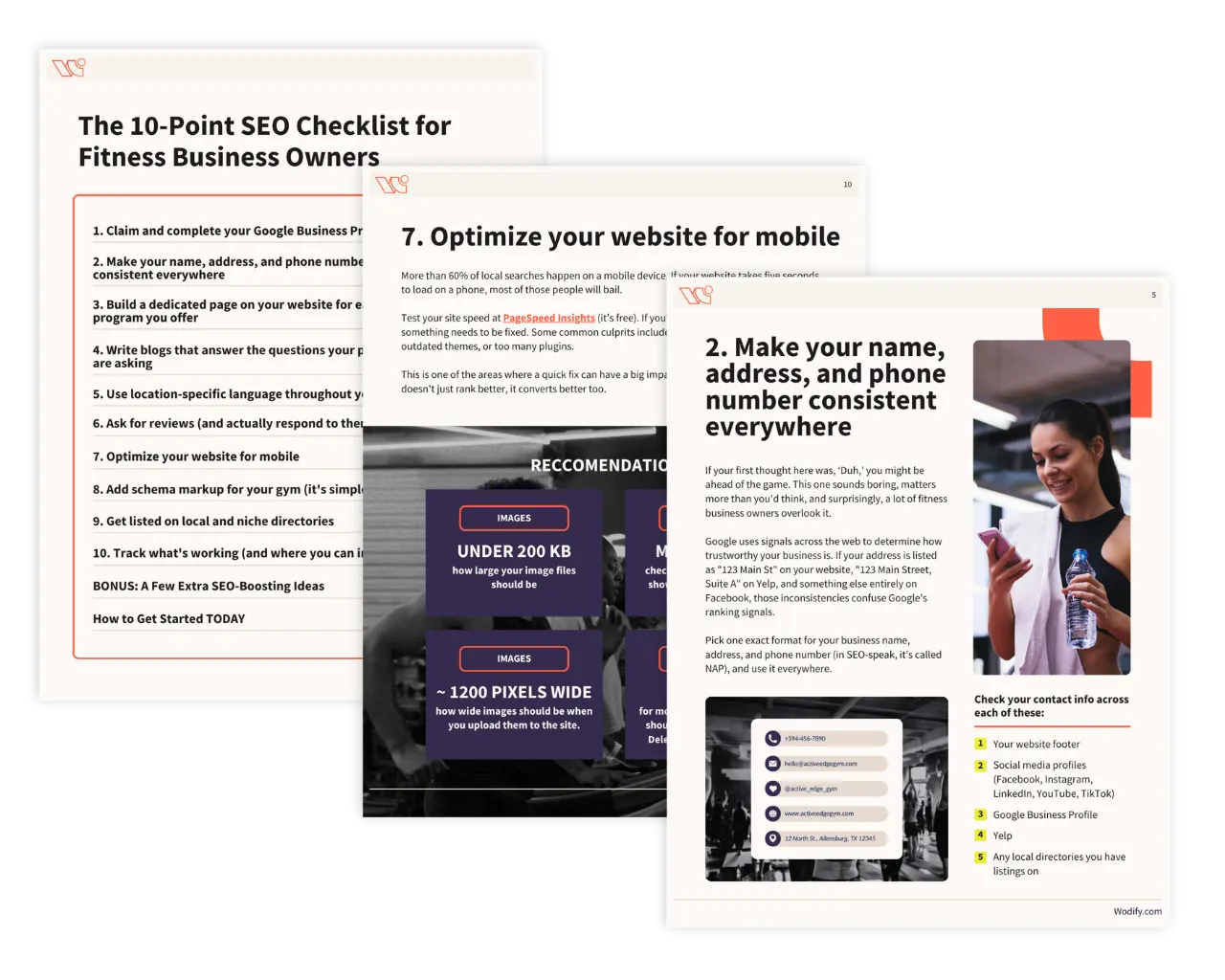
The SEO Cheat Sheet for Fitness Business Owners gives you 10 practical moves to help Google, Google Maps, AI search tools, and real people understand who you serve, where you are, what you offer, and why your business is worth choosing.
No marketing degree. No agency contract. No fluff.
Just the local SEO work that helps more prospects find your gym, studio, academy, or training business.
Just the local SEO work that helps more prospects find your gym, studio, academy, or training business.
Local SEO can sound more complicated than it really is because most SEO advice is written for marketers, not owners.
For fitness businesses, the job is more direct: help the right people in your area find the right page, trust what they see, and take the next step while they are still motivated.
That starts with your Google Business Profile. If you only do one thing, do that. Your profile is often the first thing someone sees when they search for a class, gym, studio, academy, or trainer nearby. The guide shows you which details to fill out, what photos to add, and why your services, hours, reviews, and business description all matter.
Then your website needs to back it up.
A single “classes” page may work for navigation, but it does not give search engines, AI tools, or prospects enough detail. A parent searching for kids’ martial arts, a beginner looking for CrossFit, and a former athlete looking for 24/7 gym access are not seeking the same thing. Dedicated program pages help each person find a better answer and give your business more chances to show up.
The guide also covers the details that are easy to put off but costly to ignore: consistent contact info, natural location language, review requests, mobile speed, schema markup, directory listings, and basic tracking.
None of it requires you to become an SEO expert. It gives your business the structure search engines need, and the confidence prospects need.
Because if your members love your coaching, your culture, and your community, more local people should be able to find you when they are ready to start.
Start by optimizing your Google Business Profile with accurate hours, photos, services, and location details. This profile is often the first thing potential members see and greatly boosts local visibility. Use location-based keywords naturally on your gym’s website and create dedicated pages for specific classes or services to reach a wider local audience.
Maintain consistent name, address, and phone number (NAP) information across all online directories to help search engine bots verify your gym’s legitimacy and improve rankings. Building positive reviews and earning quality backlinks from reputable websites also enhances your fitness business’s online search visibility.
For more detailed steps and examples, download the SEO Cheat Sheet for Fitness Businesses free from Wodify.
Keyword research uncovers the exact terms your target audience uses when searching for fitness services. By identifying relevant keywords with local intent and high search volume, you can tailor your website content, meta descriptions, and title tags to match what potential members are searching for. Tools like Google Keyword Planner provide valuable insights.
Understanding search intent is crucial: someone searching “fitness classes near me” likely wants to join, while “fitness tips for beginners” shows informational intent. Targeting both transactional and informational keywords attracts new and potential members while establishing your gym as a trusted fitness resource.
Download our free SEO guide for gym owners to make your fitness site perform even better in search.
Title tags are the clickable headlines in search results and should include your target keywords plus location to help your gym rank higher locally. Each page needs a unique title tag that accurately reflects its content. These are equally important to people, since they very much judge your website by the first thing they see.
Meta descriptions don’t directly affect rankings but act as persuasive summaries that encourage clicks. Craft compelling meta descriptions with relevant keywords and clear calls to action to boost organic traffic. Optimizing images with descriptive alt text and file names also helps search engines better understand your content. Wodify’s free SEO guide offers several examples of these elements.
Most local gym searches happen on mobile devices, and Google uses mobile-first indexing, prioritizing your site’s mobile version for rankings. This means that Google accesses your website as if it were on a smartphone rather than a desktop computer. A site that’s hard to navigate, slow, or cluttered on mobile will drive potential members away to competitors.
To optimize, ensure fast page loads, easy-to-tap buttons, and readable text without zooming. Use responsive design and compress images to adapt your layout across devices. Regularly test mobile usability with tools like Pagespeed Insights and Google Search Console to identify issues that could harm your gym’s SEO. The free Wodify SEO Cheat Sheet Guide explains these steps in more detail.
Norem ipsum dolor sit amet, consectetur adipiscing elit. Etiam eu turpis molestie, dictum est a, mattis tellus.
Already know which provider you want to select?
Click “Sign up Now” to lock in your choice and pick your start date. It’s quick and easy!
Looking for a bit more information or guidance? Click “Talk to Us” to arrange a call with us. We’ll help you find the perfect program tailored to your needs.
Norem ipsum dolor sit amet, consectetur adipiscing elit. Etiam eu turpis molestie, dictum est a, mattis tellus.
Norem ipsum dolor sit amet, consectetur adipiscing elit. Etiam eu turpis molestie, dictum est a, mattis tellus. Sed dignissim, metus nec accumsan.
Norem ipsum dolor sit amet, consectetur adipiscing elit. Etiam eu turpis molestie, dictum est a, mattis tellus. Sed dignissim, metus nec accumsan.
We’ll let you try Wodify for yourself and get a feel for what it can do for your business. A Wodify rep — a real person — will walk you through every feature.


"Wodify transformed how we run the gym. I now have more time to focus on growing my business and helping members thrive."Dana Bradley, Owner of Westside Fitness
Click “Talk to Us” to arrange a call so we can discuss the flexible access options that best fit your facility.
Click “Book a Demo” to learn more about how Wodify can help your business grow.
Your branded app is one conversation away. Click “Talk to Us” and our team will walk you through everything you need to get started.
Click “Book a Demo” to learn more about how Wodify can help your business grow.