

Try the #1 software for $1/month.
Norem ipsum dolor sit amet, consectetur adipiscing elit. Etiam eu turpis molestie, dictum est a, mattis tellus. Sed dignissim, metus nec accumsan.

Fitness Business Marketing
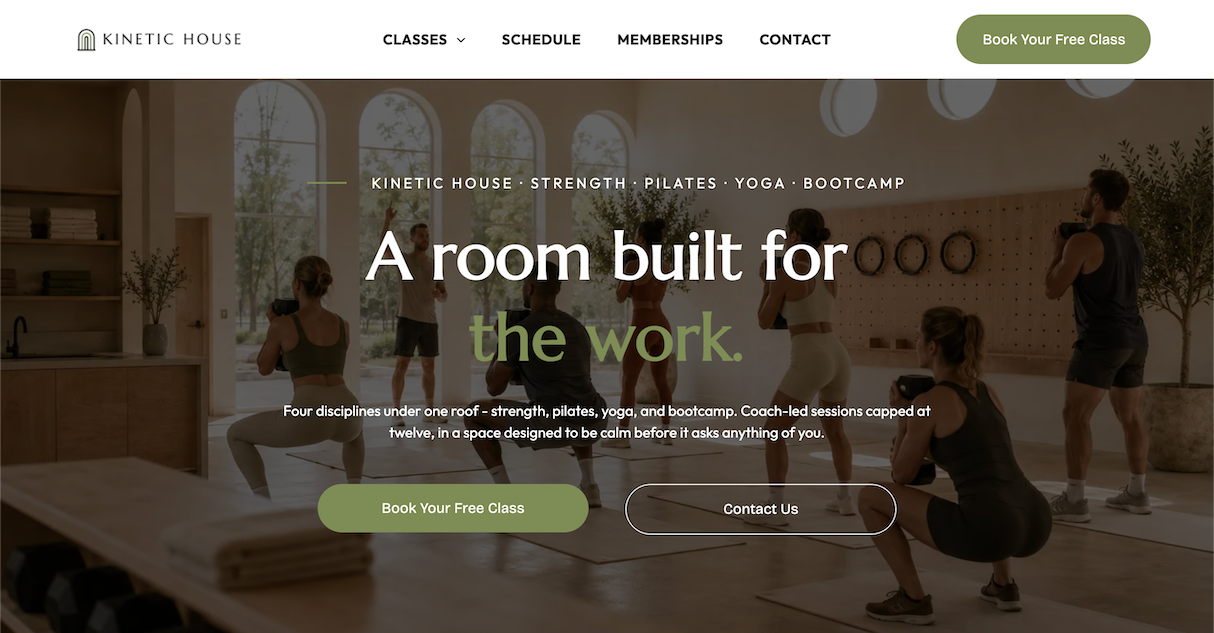
– Great gym website design should immediately tell a prospective member who you are, what you offer, and what they should do next.
– A beautiful gym website only works if people can find it through search and AI, then easily book a class, intro, or trial.
– Authentic photography, visible pricing, a real class schedule, clear calls to action, and social proof make it easier for prospects to picture themselves joining.
– Your website should clearly explain your location, programs, hours, pricing, and frequently asked questions so search engines and AI platforms can understand your business.
– Gym website templates should give you a proven structure without making your gym look like everybody else’s.
– Wodify has launched two beautiful new website templates that can be completely customized to your gym, Jiu-Jitsu school, or fitness business. They look great and are SEO- and AEO-optimized. And they are designed for lead conversion.
– Want to see how a beautiful-looking website can also drive leads and conversions? Book a demo. Or, if you’re an existing Wodify customer, schedule a call here.
Someone hears about your gym from a friend. Or sees one of your Instagram posts. Or searches for a HYROX gym, Pilates studio, Jiu-Jitsu school, or CrossFit box nearby.
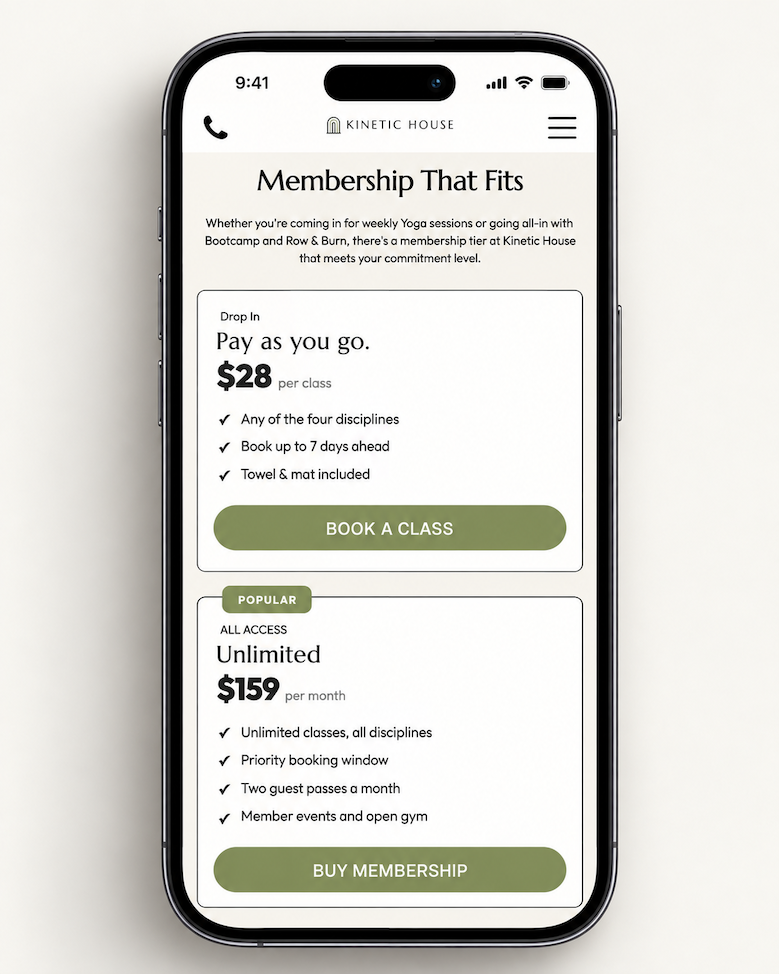
They click your website. Probably on their phone.
And within a few seconds, they’re making a judgment.
Does this place feel legit? Does it look like somewhere I’d fit in? Can I work out what they offer? How much is it? When are the classes? And, most importantly, what do I do next?
That is gym website design in the real world. From there, one of three things happens. They act right then and there. They like what they see and make a mental note to come back. Or they move on to the next gym they’ve heard about.
For your business to thrive, and for you to put food on the table, you need your website to deliver one of those first two outcomes. That’s not optional.
So a website isn’t just about picking a nice font, uploading a few photographs, and arguing over which shade of blue is your actual brand blue. Or saying “that’ll do” or “I’ll make my website nicer next month.”
Your website is making an impression before you ever get the chance to speak to that prospective member. So it has to look good. But it also has to be findable, understandable and incredibly easy to act on.
All of this is what I’m going to cover here: what the best gym website designs get right, what you should check on your own site, as well as two new Wodify Sites templates we’ve built around exactly those principles.
TL;DR: If you don’t read anything else below but the above got your attention, book a demo with Wodify.
First impressions aren’t complicated. If your gym is incredible but your website looks like it hasn’t been touched since 2020, the lead has no way of knowing that.
They haven’t met your coaches.
They haven’t walked into your facility.
They haven’t seen the community you’ve built.
They only have the website to go off.
Never forget your gym’s website design builds trust before most people even read it. That doesn’t mean every website needs to look like it was designed by a creative agency in Manhattan.
In fact, that can create the opposite problem. Your site starts looking impressive but somehow looks nothing like your actual gym. The goal is for the website to feel like you. That’s the balance. Your website should give someone a feel for your gym, whether your brand is competitive and intense, relaxed and community-led, highly technical, premium, or somewhere in between. And then it needs to get out of the way and help them take the next step.
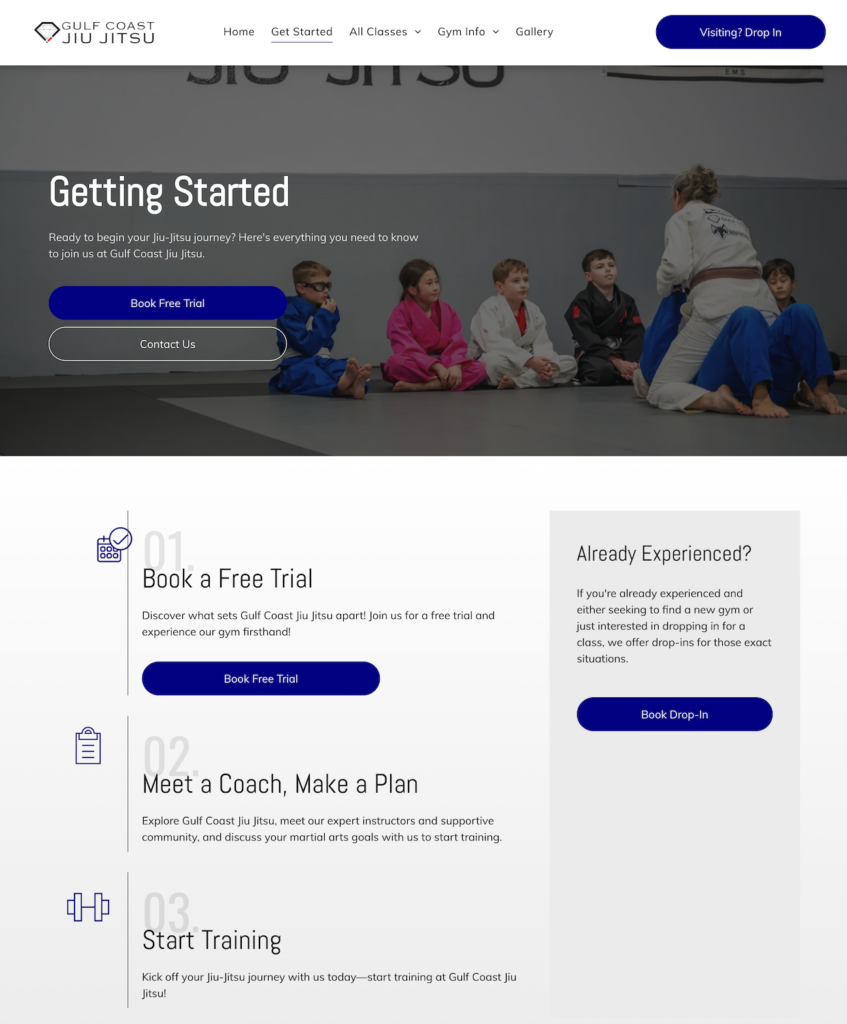
Lisa Shackelford, owner of Gulf Coast Jiu-Jitsu, described this well after moving her site to Wodify:
“The website is much sharper looking and more professional, with far better graphics and details than what I had before. My website doesn’t look like a cookie-cutter copy-and-paste website.”
You can spend months obsessing over a website. I wouldn’t recommend it. Start with these seven things.
1. A clear hero and one obvious next step.
Someone should understand what your gym does and see your main CTA without scrolling. Free trial. Book an intro. Claim a free week. Pick one.
2. Photography that looks like your gym, in its best light.
Use your coaches, members, equipment, and space whenever possible. People are trying to imagine themselves there. Give them something real to imagine, just make sure you use someone who knows how to take great photos.
3. Show people how getting started works.
If joining involves three steps, show the three steps. Remove the mystery, particularly for beginners who may already feel intimidated.
4. Put the real schedule on the website.
Don’t make someone download a PDF, create an account, or hunt through three menus just to see whether your 6 a.m. class exists.
5. Make pricing understandable.
You don’t need every possible membership permutation on your pricing page, but give people enough information to understand what joining will likely cost.
6. Use social proof from real members.
Testimonials, reviews, member stories, and genuine photographs tell visitors that real humans already trust you.
7. Design for the phone and the desktop
Open your website on your own phone. Try to find pricing. Find tomorrow’s classes. Book a trial. If it’s annoying for you and you know where everything is, imagine being a first-time visitor.
If you want to see these principles on real gyms, check out my roundup of gym website examples.
We’ve just added two new starting points to Wodify Sites, and I say starting points deliberately.
A template shouldn’t mean swapping Gym A’s logo for Gym B’s logo and calling it custom.
Every Wodify Site starts with a proven structure, then we custom-adapt it to the gym’s style and brand, including fonts, colors, button styles, layouts, pop-ups, banners, and backgrounds. The photography and content come from the gym too, so the finished site should feel like the business it represents, not the demo template it started from.
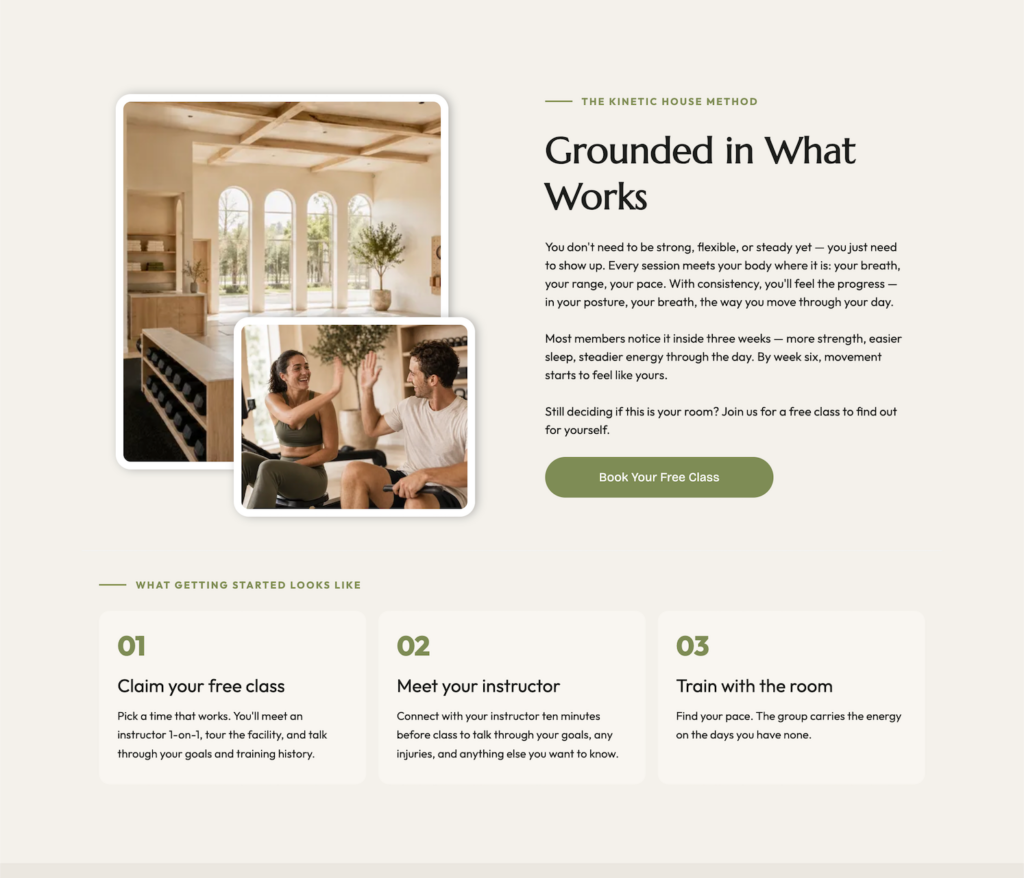
We call the first new design style “Nova”. It’s soft, organic, and approachable.
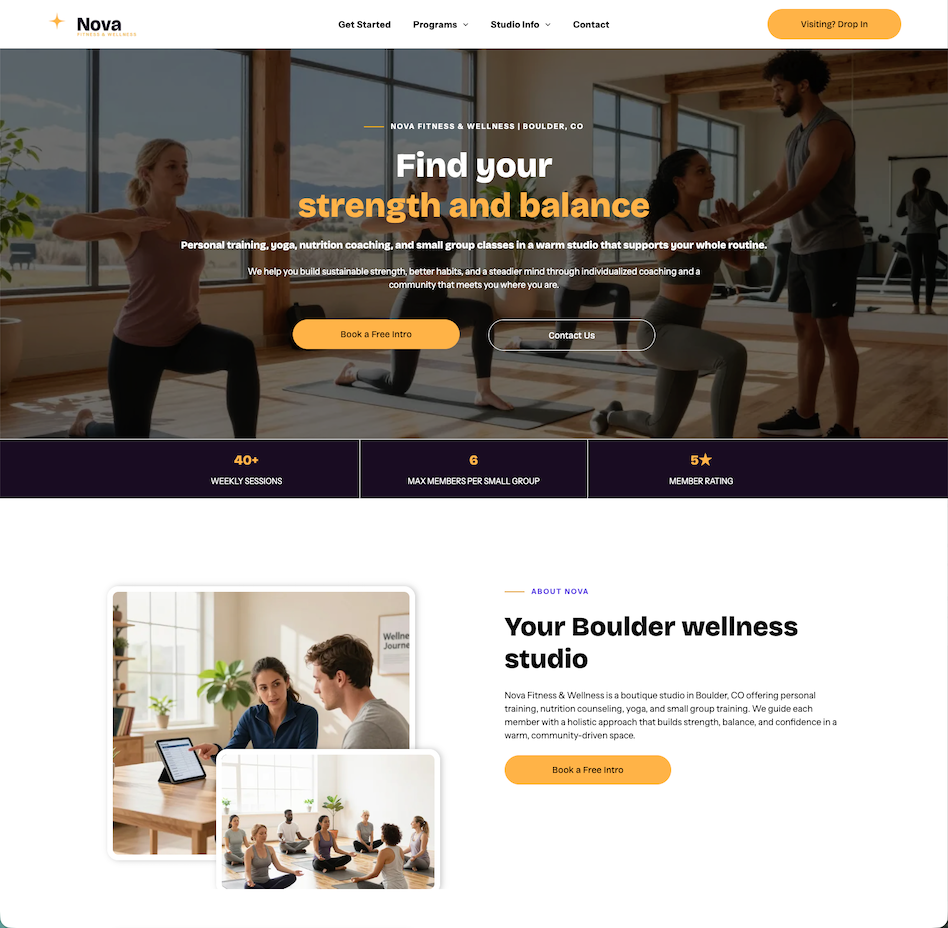
Nova is the more relaxed, organic-feeling of the two new templates Wodify has launched. There’s more breathing room. Softer shapes. A lighter visual rhythm. It feels modern and polished without feeling intimidating. That naturally makes it a strong option for boutique fitness and wellness businesses, but I wouldn’t pigeonhole it there. Nova could work just as well for a functional fitness gym, HYROX affiliate, or strength business that wants to lead with community, accessibility, and a strong visual identity rather than a harder-edged training-floor aesthetic.
The homepage gives you room for a strong hero and clear calls to action, followed by proof points about the business. From there, it starts answering the questions a prospective member is already thinking about. How do I start? What types of classes do you offer? What does membership cost? Do people like it here?
Nova includes a simple three-step getting-started section, visual cards for classes, member testimonials, membership pricing, FAQs, a contact and lead-capture area, social content and a strong closing CTA.
The important distinction when designing a gym website isn’t really what kind of gym you run. It’s how you want your gym to feel when somebody encounters it for the first time.
If your brand is modern, welcoming, and approachable, Nova gives you a strong starting point.
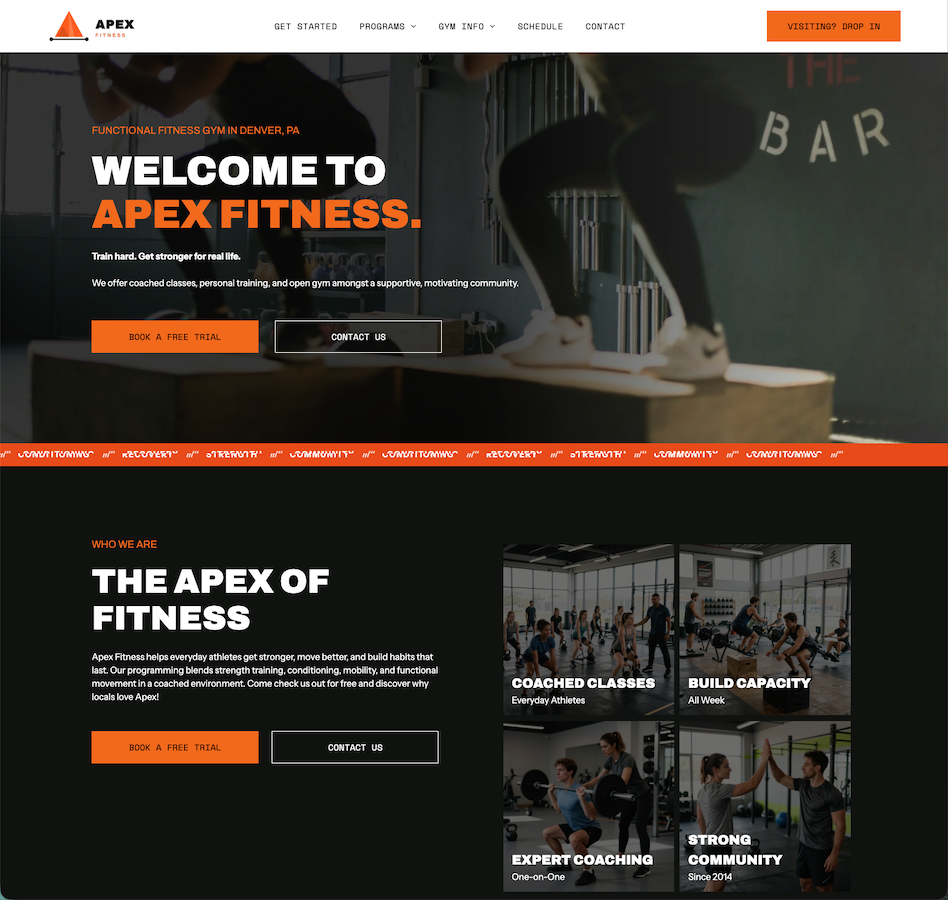
We call the second new design style “Apex”. It’s bold, direct, and performance-led.
Apex goes in a different direction from Nova. Contrasting backgrounds. Strong typography. Big headlines. More visual intensity. It’s an obvious fit for brands that want their website to feel closer to the energy of the training floor. That might be CrossFit, HYROX, strength and conditioning, performance training, or another gym with a more direct visual personality. But again, it’s a style choice, not a rule about the type of fitness business you run.
For any gym website, there’s a clear first-time visitor journey: class information, an embedded live class schedule, straightforward membership pricing, member stories, an easy way to book a class, a free-intro form, FAQs, social content, and CTAs that are always bold and easy to find.
Two gyms can offer similar services and still have completely different brands; your website should reflect what makes you unique, but it shouldn’t ignore the standards and norms a potential member needs to easily book a class at your gym. Don’t make it hard for them to navigate your website or book a class. If your gym or martial arts school requires people to book an intro class, make it easy for them to book (and, if required, pay) for it. In a world where people are used to doing everything online, texting, not calling, buying from Amazon in seconds…if you put an inquiry form on your website and now you have to call them and they have to pick up…there’s a good chance they will be intimidated, nervous, or just feel like it’s all too hard.
A good example of these principles working together is FTX Performance in Boca Raton, Florida.
FTX is a boutique fitness gym and recovery club offering HIIT group fitness classes and specialist HYROX classes.
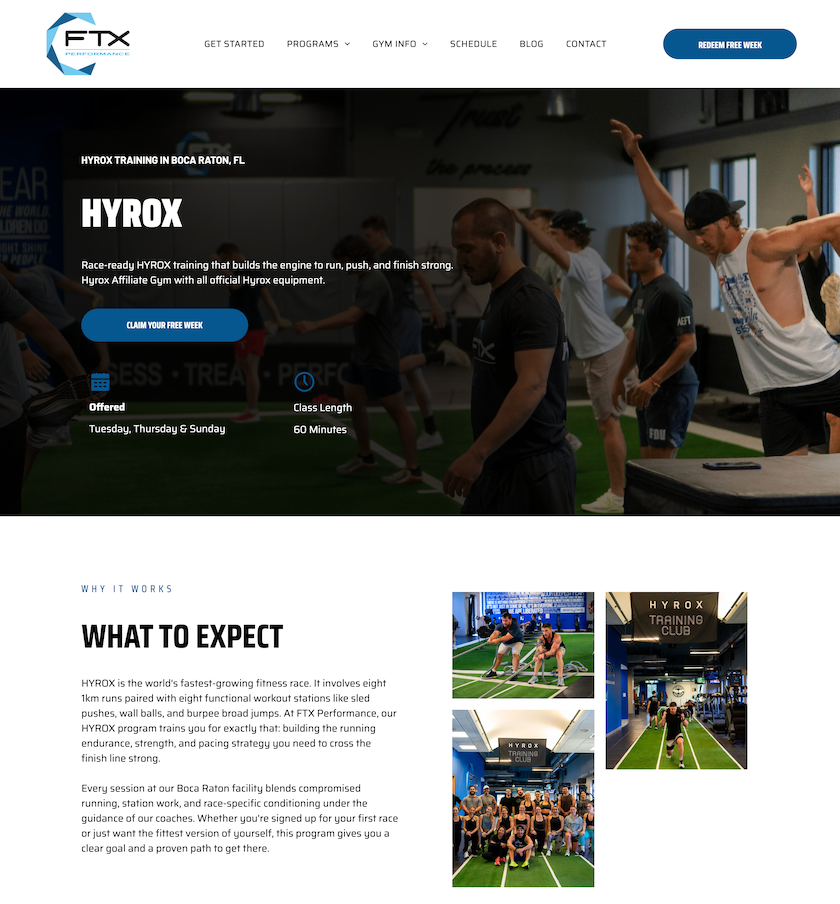
The things the site gets right are extremely simple; it tells you what it is, where it is, and makes it easy for the lead to take the next step:
This is what I mean when I say a website should do more than look nice. You know where they are. You know what they do. You know how to start. And you start getting a sense of who they are. Beautiful is only half of it, and as important as that is, clear communication and easy conversion also count.
Lead forms can flow into Wodify and trigger automated follow-up workflows. The live class schedule can sit directly on the website while being managed from Wodify, so you’re not maintaining the same schedule twice. Coach information can stay synchronized between the site and member experience, and daily workouts can be published to a live page on the website.
Mike Collette from Prototype Training Systems calls out this lead conversion as an “aha” moment:
“The coolest part [of using Wodify for my website] is when a lead comes in, syncs into the system, and the automated follow-up actually works. They respond, and the whole thing feels personal, not robotic.”
Prospective members are never aware of “optimized conversions”, but they’re a big part of it because your website makes it easy for them to sign up. With Wodify, three in four businesses see more leads after launching. And four in ten businesses double their leads.
A website isn’t just prettier with Wodify; it’s connected to what happens next.
Wodify Sites is our full-service gym website builder. Full-service is important. You aren’t handed a blank screen and wished good luck. We build the site from a conversion-focused starting point, adapt the design to your brand, and handle core SEO setup and AI search (AEO) including metadata, local schema, Google Search Console, redirects and content optimization.
After launch, you can still make updates yourself through the site editor, or get help from the Wodify Sites team. You also get access to site performance reporting within Wodify. And because the website lives alongside the rest of Wodify, your lead capture, workflows, schedule and booking experience don’t have to become another pile of disconnected tools.
Danielle Sirico from Odyssey Brazilian Jiu-Jitsu puts one benefit very simply:
“Allowing potential students to book intro classes right away through Wodify has made the intro process so much easier.”
Book a demo, and we’ll show you what your gym could look like with Wodify Sites.
What makes a good gym website design?
A good gym website immediately explains what your gym offers, who it’s for and what a visitor should do next. It should use authentic imagery, work well on mobile, show useful information like programs, schedules and pricing, and make booking easy. Good design builds trust, but clarity and ease of use are what turn that trust into action.
How much does a gym website cost?
Gym website pricing varies depending on whether you build it yourself, hire an agency, or use a managed website service. Costs can include design, hosting, SEO, maintenance, and software integrations. For Wodify Sites, it’s only $299 setup + $99/month. Compare this affordable monthly cost to paying a designer thousands of dollars, managing hosting, and needing a developer every time you want to change your website.
Do gym website templates look generic?
They can, but they don’t have to. A good gym website template gives you the underlying structure while leaving room for your brand. Fonts, colors, photography, buttons, backgrounds, layouts, and messaging should reflect your actual gym. The template is the starting point, not the finished identity.
What pages should a gym website have?
Most gym websites should include a homepage, program or service pages, schedule, membership or pricing information, an About page, contact and location information, and FAQs. Depending on the business, you may also want dedicated coach pages, testimonials, a blog and separate pages for important programs such as HYROX, CrossFit, Pilates or Jiu-Jitsu.
How do I get my gym to show up in ChatGPT or Google AI answers?
There is no guaranteed way to appear in AI answers, but you can make your business easier to understand. Clearly state what you offer and where you’re located, keep your business information consistent, create pages for individual programs, use schema on the pages, publish useful FAQs, keep hours and pricing current, use structured data, and keep your Google Business Profile and reviews active.
How long does it take to launch a new gym website?
The timeline depends on how complicated the site is and how quickly content, photography and approvals are available. A small gym website can usually move faster than a large multi-location site with dozens of programs. The best way to avoid delays is to have your brand assets, current pricing, schedule, program information, photography, and business details ready before the build starts.
Can I edit my gym website myself?
Yes, if your website platform includes an editor. Wodify Sites customers can make self-service updates after launch while still having access to ongoing support. That gives owners control over everyday changes without requiring them to personally build or maintain the entire website.
Should I put pricing on my gym website?
In most cases, you should give prospects enough pricing information to understand what joining will cost. Hiding every price can create unnecessary friction. If your memberships are more complicated, show your core plans or starting prices and explain what happens next. Pricing should help someone move forward, not make them call just to find out whether the gym fits their budget.
Norem ipsum dolor sit amet, consectetur adipiscing elit. Etiam eu turpis molestie, dictum est a, mattis tellus.
Already know which provider you want to select?
Click “Sign up Now” to lock in your choice and pick your start date. It’s quick and easy!
Looking for a bit more information or guidance? Click “Talk to Us” to arrange a call with us. We’ll help you find the perfect program tailored to your needs.
Norem ipsum dolor sit amet, consectetur adipiscing elit. Etiam eu turpis molestie, dictum est a, mattis tellus.
Norem ipsum dolor sit amet, consectetur adipiscing elit. Etiam eu turpis molestie, dictum est a, mattis tellus. Sed dignissim, metus nec accumsan.
Norem ipsum dolor sit amet, consectetur adipiscing elit. Etiam eu turpis molestie, dictum est a, mattis tellus. Sed dignissim, metus nec accumsan.
We’ll let you try Wodify for yourself and get a feel for what it can do for your business. A Wodify rep — a real person — will walk you through every feature.




"Wodify transformed how we run the gym. I now have more time to focus on growing my business and helping members thrive."Dana Bradley, Owner of Westside Fitness
Click “Talk to Us” to arrange a call so we can discuss the flexible access options that best fit your facility.
Click “Book a Demo” to learn more about how Wodify can help your business grow.
Your branded app is one conversation away. Click “Talk to Us” and our team will walk you through everything you need to get started.
Click “Book a Demo” to learn more about how Wodify can help your business grow.