



Try the #1 software for $1/month.
Norem ipsum dolor sit amet, consectetur adipiscing elit. Etiam eu turpis molestie, dictum est a, mattis tellus. Sed dignissim, metus nec accumsan.

Martial Arts School Management

Packed mats feel like success. Your evening classes are full, new students keep showing up, and membership payments arrive every month.
But a busy martial arts academy can still struggle to produce healthy profit margins. Payroll may be climbing. Failed payments may sit unresolved. Instructors may spend too much time on administrative work. Popular classes may be overcrowded while other parts of the schedule stay half empty.
Conducting a martial arts business audit helps you see what enrollment metrics alone cannot. The audit looks at how the school turns students, classes, staff time, and floor space into a sustainable business.
Those questions apply across Brazilian Jiu-Jitsu, karate, Taekwondo, Muay Thai, boxing, mixed martial arts, self-defense, and traditional martial arts. Every school has its own programs, pricing, instructors, target market, and culture. Every school still has to cover payroll, rent, insurance, software, marketing, equipment, and owner compensation.
You do not need dozens of KPIs to start. Focusing on seven metrics will tell you a lot.
A useful business metric leads you to making better decisions. If a metric does not help you optimize pricing, staffing, scheduling, retention, billing, or marketing, it probably does not need to be on your monthly scorecard.
| Metric | What It Measures | How to Calculate |
|---|---|---|
| Admin time | Time spent on recurring administrative work | Track weekly hours spent on billing, scheduling, leads, attendance, and other admin |
| Instructor utilization | How much paid instructor time is spent teaching | Teaching hours ÷ total paid instructor hours × 100 |
| Revenue per student | Average recurring revenue from each active student | Monthly recurring revenue ÷ active students |
| Class utilization | How much of each class’s practical capacity is being used | Average class attendance ÷ practical class capacity × 100 |
| Failed payments | Share of expected recurring revenue that remains unpaid | Unresolved recurring charges ÷ recurring charges due × 100 |
| Student retention | Share of students who remain active over a set period | Students retained ÷ students at the start of the period × 100 |
| Lead conversion | Share of qualified leads that become paying students | New students ÷ qualified leads × 100 |
These numbers work best in context to the reality of your business vs. in isolation.
A martial arts school can grow enrollment and still weaken financially if payroll, discounts, and facility costs rise faster than revenue. Another school may add fewer new students but improve cash flow because existing students stay longer, classes run more efficiently, and less money gets stuck in unpaid invoices.
Use your current numbers as the baseline. Then compare 30-day, 90-day, and annual trends instead of chasing a generic benchmark that may have little to do with your school.
Your first business audit does not need to become a week-long reporting project. Block an hour and pull enough information to find the first problem.
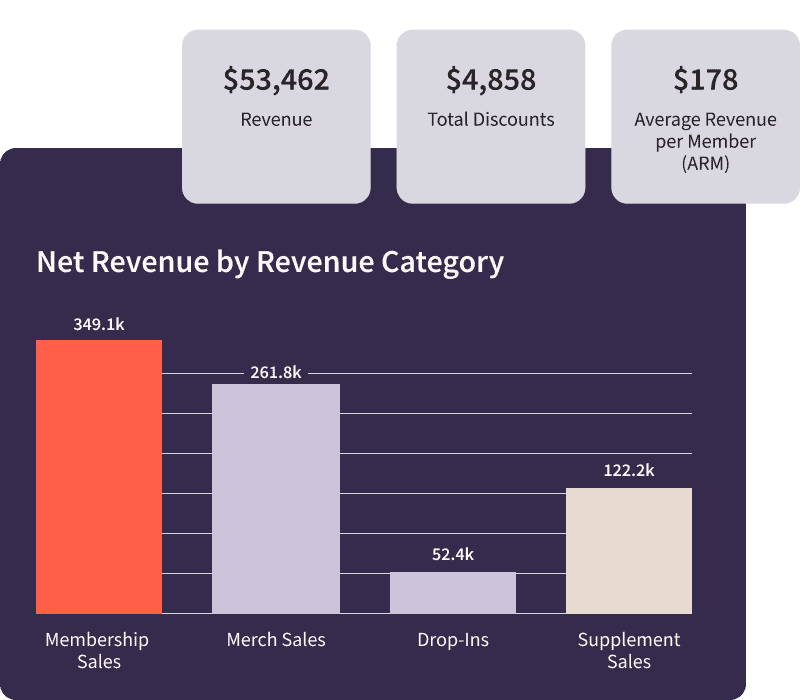
Do not try to fix everything you find. If $2,000 is sitting unpaid, start there. If active leads are waiting days for a response, fix the follow-up process. If the owner is spending 15 hours per week on repetitive administrative tasks, trace where those hours go.
One operating problem fixed is more useful than a perfect dashboard that changes nothing.
Many martial arts school owners entered the industry as instructors first. They wanted to teach martial arts, help students improve, and build a community. Business management arrived one responsibility at a time: billing, waivers, family accounts, class scheduling, belt tests, payroll, leads, attendance, staff coverage, and reporting.
Eventually, the owner can spend as much time managing the machinery around the school as coaching inside it.
Track two normal weeks of administrative work. Group the time into billing, scheduling, attendance, memberships, waivers, lead follow-up, student communication, rank management, reporting, and staffing. Then separate work that requires judgment from work that simply repeats.
Talking with a parent about a student’s progress needs a person. Sending the same trial reminder to every prospect does not. Neither does checking the same failed invoice every morning or copying attendance from one system to another.
Martial arts management software can keep family memberships, payments, attendance, class and instructor scheduling, communication, and belt or rank tracking in one system. For school owners, the useful part is straightforward: fewer repetitive tasks competing with coaching, sales, and student relationships.

A process that only exists in the owner’s head is difficult to hand off. Document what happens when a lead requests a trial, a payment fails, a student stops attending, someone becomes eligible for a belt test, or an instructor needs coverage.
Keep each process simple. Who owns the task? What happens next? When should it happen?
This becomes more important as the school grows. A martial arts school owner may remember every student and billing exception at 40 members. The same approach becomes fragile with 150 students, several instructors, youth programs, private lessons, and multiple locations.
Written systems also make automation easier because the school has already decided what should happen.
For most school owners, “instructor utilization” is less useful than a simpler question: what happens during the hours you pay instructors?
Instructor utilization formula:
Teaching hours ÷ total paid instructor hours × 100
Then inspect the rest of the paid time. Martial arts instructors may prepare classes, clean the mat, meet parents, coach advanced students, handle belt tests, teach private lessons, or plan specialized training. Those activities can all support the school.
The problem is paid time without a purpose. Two instructors may regularly cover a class with six students. Another coach may have a 45-minute paid gap between sessions. A head instructor might spend an hour after every class updating records that could have been handled during check-in.
Those patterns tell you something about class scheduling, staffing, and administrative systems.
Rank matters in martial arts, but rank alone does not make someone a good instructor. A talented martial artist may struggle to explain basic movement to a beginner, while kids classes require patience, communication, safety awareness, and classroom control.
Look at technical ability alongside the ability to teach different skill levels and age groups. Self-defense students may need a different coaching style from an advanced competition team. Young adults may respond differently than five-year-olds.
A successful martial arts school needs instructors students can learn from and want to train with again.
Park’s Taekwondo is a family-run martial arts school that uses Wodify for automated billing, attendance tracking, and belt progress across beginner Taekwondo, advanced Taekwondo, teen and adult classes, and its competitive sparring team.
That example matters because the operating work is familiar. Billing, attendance, and progression all need to happen regardless of how busy the mat is. Moving those jobs out of paper-heavy or manual processes gives staff fewer details to carry in their heads and more time for students.
Total monthly revenue tells you how large the business is. Revenue per student tells you more about how the membership model is working.
Revenue per student formula:
Recurring monthly membership revenue ÷ active students
If 150 active students produce $22,500 in recurring membership revenue, average revenue per student is $150.
Break that average apart before drawing conclusions. Adult memberships may have one rate, kids programs another, and family discounts can pull the average down. Long-time students may still be paying prices set several years ago. Private lessons or specialty programs may raise average revenue for a smaller group of students.
A falling average revenue number is not automatically bad. A lower-priced youth program may be filling unused class times and contributing healthy profit. The important question is why the number changed.
Legacy pricing tends to accumulate. A martial arts school owner sets an early membership rate, protects it for existing students, adds a family discount, runs a promotion, and later changes the standard price. Several years later, students receiving similar services may be paying very different amounts.
Review your martial arts pricing models against the cost of running the business today. Look at adult and youth memberships, limited plans, unlimited plans, family discounts, paid-in-full agreements, drop-ins, and private lessons.
Don’t raise or lower prices simply because another school did. Know your average revenue per student, costs, retention, and target market first. Then decide whether your current pricing still supports the experience you provide.
Private lessons can make good use of quiet periods and give students access to specialized training, competition preparation, self-defense instruction, or focused technical help.
Run the economics separately from group classes. A $90 private lesson during an otherwise unused afternoon hour may be attractive. A $90 lesson that displaces a full evening class creates a very different tradeoff.
Compare lesson revenue with instructor pay, facility use, demand, and the value of whatever else could happen during that hour. Small groups deserve the same analysis because the lower student-to-instructor ratio changes the economics.
Many school owners ask what a good martial arts school profit margin should be. Your own break-even point is more useful.
Add the recurring monthly expenses required to operate the school. Include rent, payroll, insurance, software, utilities, marketing, merchant fees, equipment, taxes, debt payments, and other normal operating costs.
Break-even student calculation:
Monthly operating costs ÷ average monthly recurring revenue per student
Suppose normal monthly operating costs are $22,000 and average recurring revenue per student is $150. Dividing $22,000 by $150 gives you roughly 147 student equivalents.
That is a planning shortcut rather than a full profit-and-loss calculation. Variable costs, owner compensation, private lessons, merchandise, events, and other revenue can change the final result.
It still gives the martial arts school owner something concrete to work with. A school with 115 students and a break-even estimate near 147 needs a different plan from a school with 180 students that is still barely covering expenses.
This analysis helps uncover gaps where a martial arts studio may need more enrollment, better pricing, or lower costs.
You only have so much mat space, and student demand usually clusters around a limited number of hours. Class scheduling is therefore part of the financial model, not just a calendar problem.
Pull 8 to 12 weeks of attendance and compare classes by day, time, instructor, program, skill level, age group, average attendance, and peak attendance.
Some group classes will be full week after week. Others will hold steady at a comfortable size. A few may still be on the schedule because they have always been there.
Do not add another class because three students asked for one. Look for repeated demand. At the same time, do not keep paying an instructor to run an underused session indefinitely without understanding why attendance remains low.
A kids Taekwondo class does not use the floor the same way as advanced Brazilian Jiu-Jitsu. Boxing, mixed martial arts, self-defense, sparring, grappling, private lessons, and small groups can require different amounts of space and instructor attention.
Set practical capacity for each program, then compare average and peak attendance with that number.
Overcrowding can hurt coaching quality and the student experience. Consistently empty mat space may point to weak demand, an inconvenient time, poor promotion, or a class that no longer belongs on the schedule.
Quiet hours can also make money differently. Private lessons, beginner courses, small groups, open mats, seminars, belt test preparation, competition training, camps, and birthday parties may fit those periods better than another recurring group class. Use student requests, waitlists, trial inquiries, and attendance patterns to decide which offers deserve a test.
Kids martial arts programs often operate differently from adult memberships. The child takes the class, but the parent usually chooses the school, pays the bill, manages transportation, and decides whether the family stays enrolled.
That changes what the business needs to monitor. Parents may care about schedule, instructors, communication, cleanliness, safety, confidence, discipline, self-improvement, and visible progress in addition to the martial arts itself.
If youth students make up a meaningful part of your student base, review trial conversion, student retention, family discounts, class capacity, instructor coverage, and belt progression separately from adult classes.
Family accounts also affect the financial picture. A discount that works well for two siblings may look different when several family members attend frequently. Compare actual family revenue with class usage before assuming every family pricing structure is helping the business.
A membership sale is not complete when the agreement is signed. The money still has to be collected. Failed payments deserve their own line in the monthly audit because they represent expected revenue that has not reached the bank account.
Failed payment rate calculation:
Unresolved recurring charges ÷ recurring charges due
If the school bills $25,000 in recurring memberships and $1,000 remains unresolved after the normal collection period, the collection gap is 4%. More useful than the percentage is the $1,000 itself. If the same gap happened every month, $12,000 in expected annual revenue would remain uncollected.
That is an example, not an industry benchmark. Use your own billing numbers.
Wodify’s Automated Billing can retry eligible failed invoices when the invoice is due or overdue, Auto Bill is enabled, and a default payment method is on file. School owners can also configure how many retry attempts are allowed for credit cards and bank accounts.

The school still needs a policy around those tools. Decide when the student or parent hears from you, how many automatic attempts make sense, and when a staff member takes over. That keeps billing consistent instead of turning every failed card into a new judgment call.
A school can hide a retention problem behind constant enrollment. Start a month with 150 students, add 12 new students, and lose 10 existing students. Marketing produced 12 memberships, but the school only grew by two. If that pattern continues, acquisition has to work constantly just to replace students who leave.
Track retention by membership type, program, age group, instructor, length of membership, and attendance pattern. Add cancellation reasons whenever possible. A student retention strategy becomes much more useful when you can see what changed before someone canceled.
A student who normally trains three times per week rarely goes from fully engaged to canceled without some change in between. Attendance may fall to once per week, followed by two missed weeks and a brief return before the student disappears again.
Those changes give the school time to respond.
The reason may be work, family, cost, injury, motivation, or a schedule conflict. An instructor who knows the student can respond differently once the reason is clear. Do not wait for the cancellation email to start the retention conversation.
Martial arts has a built-in way to make progress visible through belts, ranks, stripes, attendance milestones, skill requirements, competitions, and other student achievements that can show a martial artist that training is moving somewhere.
That journey looks different for each student. A beginner may be focused on the first promotion. Advanced students may spend much longer between ranks. Someone else may care more about personal growth, fitness, competition, or self-defense than the next belt.
The school should track the belt progression system it actually uses. Wodify’s martial arts tools support customizable belt and rank structures, attendance records, progression criteria, and rank history, giving instructors another source of context when a student’s participation changes.
Student retention also has a human side. Training partners expect each other to show up. Parents see the same families every week. Advanced students help beginners, and instructors learn which students need encouragement.
Open mats, seminars, competitions, workshops, student celebrations, and special events can strengthen those relationships, but a school does not need a packed event calendar to build community. Consistent coaching, reliable classes, and people knowing each other by name do much of the work.
See also: 6 Marketing Ideas to Fill the Mats at Your Martial Arts School
Website traffic is not student enrollment. Neither are Instagram followers, Google impressions, or a full inbox of inquiries. You could literally spend all week on marketing, but the reality is you have to be intentional with your time and effort — we recommend optimizing your lead conversion process first.
Track the path from initial interest to paid membership:
Inquiry → response → trial booked → trial attended → membership
Each transition points to a different business problem. Lots of inquiries but few trials may indicate slow follow-up or an unclear offer. Strong trial attendance with weak enrollment may point to the trial experience, pricing, schedule, or fit with the target market.
Don’t increase ads or mailers while current leads are sitting unanswered. Fix the underlying conversion workflows first.
Wodify Automation Workflows can automate lead follow-up, trial reminders, onboarding, retention communication, missed-payment recovery, and staff tasks. Wodify’s current approach also includes help from its team to build automations where a business is losing time or revenue.
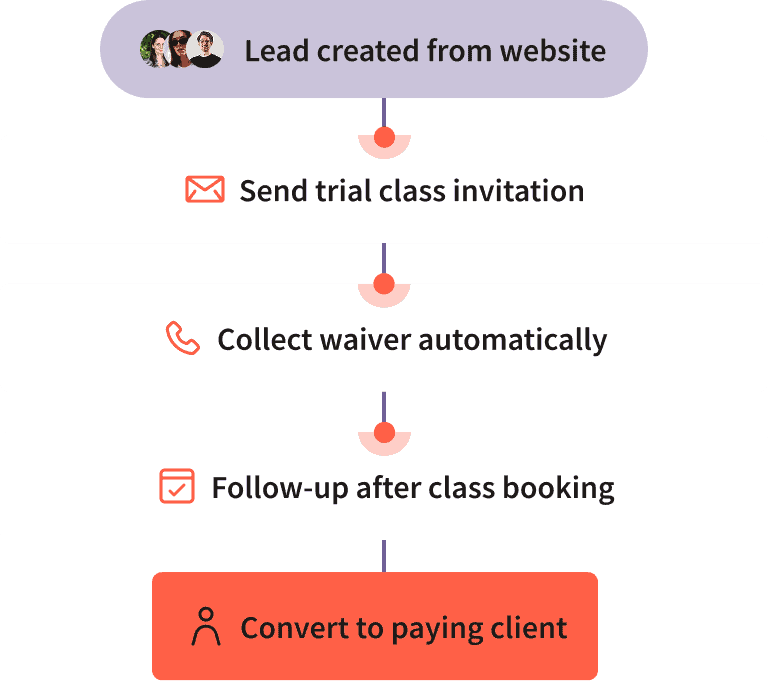
Automation should make the school faster without making it feel impersonal. A system can acknowledge the inquiry, provide trial details, and keep follow-up moving. A staff member should handle the conversation where judgment and connection matter.
Martial arts is a local business. Students may discover a school through social media or a referral, but they still need a practical reason to train there several times per week. A key part of attracting students is showing up on Google search, specifically for local searches.
Keep your Google Business Profile current with the correct name, address, phone number, website, business hours, photos, and programs. Google reviews can give prospective students context about instructors, beginner support, kids classes, cleanliness, culture, and the training experience.
Wodify has developed comprehensive website and SEO guides for business owners:
Your website should answer the same practical questions a prospective student would ask at the front desk.
Clear answers help people decide, and they also give search engines and AI systems better information about the school.
A useful martial arts website reflects the business that exists.
A BJJ academy may need separate information for adult Jiu-Jitsu, kids BJJ, competition training, and private lessons. A larger martial arts school may offer Taekwondo, karate, mixed martial arts, boxing, or self-defense programs.
Name the style. Describe the instructors. Explain the skill levels and who the class is for. Give prospective students enough information to understand what actually happens after they walk through the door.
Do not create six nearly identical pages because six relevant keywords appear in an SEO tool. Strong search and AI visibility come from specific entities and clear relationships between them.
Marketing tip: Sell your story about why you became an instructor, how you got into martial arts, passion for student growth, and even hobbies. These do more for growing your brand than explaining generic information like “What is Karate?”
Recurring memberships usually carry the martial arts school business. Still, private lessons, workshops, seminars, camps, birthday parties, uniforms, gloves, protective equipment, and T-shirts can add revenue when they fit the operation.
Review each of these revenue sources as its own small business case.
A seminar that fills a quiet Saturday may be a good use of the facility. Merchandise that sits unsold for a year ties up cash. Do the math instead of assuming every new revenue stream is good revenue.
“How much does a martial arts school owner make?” does not have one useful answer because owners can receive money in different ways. Salary pays the owner for work performed. Profit is what remains after business expenses. Distributions move some of that profit to the owner. Keep those numbers separate.
This distinction matters when the founder teaches group classes, handles sales, manages instructors, runs billing, and does the marketing. A school may appear profitable because the owner performs several jobs without assigning a cost to that labor.
If the business plan eventually calls for fewer owner hours, someone else will need to do that work. Account for the labor before hiring, rather than discovering afterward that the apparent profit depended on free founder time.
There is no useful universal answer to how much it costs to start a martial arts business. Facility condition, lease terms, location, martial arts styles, equipment, and staffing can change the number dramatically.
A former fitness studio may need mats and signage. An empty retail unit may require flooring, bathrooms, HVAC work, walls, and a larger buildout. Boxing and mixed martial arts may add heavy bags, a ring, cage equipment, or other specialized training gear.
Build the business plan from local quotes for the lease deposit, construction, mats, equipment, insurance, registrations, software, website, signage, marketing, initial payroll, and working capital. Then calculate the student count needed to support that operating model.
A broad startup estimate from another city is less useful than your own rent quote and break-even calculation.
New locations can increase annual revenue, but they also add rent, payroll, instructors, billing, class schedules, and more places for a weak process to repeat. Before signing another lease, test the first location without the owner.
Can staff handle billing questions? Do instructors understand promotion requirements? Are prospective students followed up consistently? Can someone else review attendance, retention, and revenue without building another spreadsheet?
Multiple locations work better when the first school has documented systems, reliable staff, and enough management capacity to operate without the founder solving every exception.
A second location should copy a working operating model, not give the owner a second set of the same problems.
A martial arts school owner often knows the question before knowing which report to open. Which classes have lost attendance? Which former students should the school contact? Did revenue change over the last 90 days? Are some class times consistently underused?
Ask Wodify can analyze business data around member engagement, revenue, retention, trends, and schedule performance. It can also help identify former members for re-engagement or examine attendance patterns when a school is considering schedule changes.

The owner still makes the decision. The useful part is shortening the path from a business question to the information needed to answer it.
Fill this out once per month. Keep the definitions the same so you can compare performance over time.
| Metric | My number | 90-day trend | What needs attention? |
| Weekly admin hours | ______ | ↑ ↓ → | __________________ |
| Instructor utilization | ______% | ↑ ↓ → | __________________ |
| Revenue per student | $______ | ↑ ↓ → | __________________ |
| Class utilization | ______% | ↑ ↓ → | __________________ |
| Failed payment rate | ______% | ↑ ↓ → | __________________ |
| Student retention | ______% | ↑ ↓ → | __________________ |
| Lead conversion | ______% | ↑ ↓ → | __________________ |
| Break-even student count | ______ | ↑ ↓ → | __________________ |
After filling it out, put each issue into one of three groups:
Choose one or two fixes. Failed payments often belong near the top because they involve revenue already earned. Missed leads deserve attention when demand already exists. Retention problems can be more expensive than a weak month of new enrollment because marketing must continually replace the students who leave.
Pricing, staffing, schedule changes, and expansion usually need more analysis because they affect several parts of the business at once.
Busy mats should eventually give a martial arts school owner more options: more time coaching, a stronger staff, new programs, another location, or simply more time away from the front desk. That only happens when the systems underneath the school can carry the growth.
Know how much each student contributes. Watch where leads stop moving. Review class attendance before changing the schedule. Recover failed payments. Notice when students begin disappearing. Make sure instructors spend their paid time on work that supports students and the school.
Then run the audit again next month.
Wodify puts martial arts memberships, family accounts, scheduling, billing, attendance, belt and rank tracking, lead management, communication, reporting, and automation in one platform. For an owner, that means fewer disconnected processes and more visibility into the parts of the business that need attention.
Book a personalized demo to see how Wodify can transform the way your martial arts school operates.
Start with administrative time, instructor utilization, revenue per student, class utilization, failed payments, student retention, and lead conversion. School owners can add metrics as the business gets more complex, but these seven cover many of the problems that directly affect cash flow, owner time, enrollment, and daily operations.
A successful martial arts school pairs good instruction with a business model that supports it. Students need reliable classes, instructors they trust, visible progress, strong communication, and reasons to keep training. The owner also needs control over billing, pricing, staffing, scheduling, retention, and lead generation. Long-term success depends on both sides working together.
Martial arts schools can be profitable, but there is no universal profit margin that applies to every school. Rent, payroll, membership prices, student count, owner compensation, debt, and facility costs all affect the result. Calculate break-even students, operating profit, and owner compensation from your own financial statements instead of relying on an unsupported martial arts industry average.
There is no dependable single salary for a martial arts school owner. Income depends on school revenue, profit, hours worked, teaching responsibilities, payroll, rent, and how the business is structured. Separate salary for work performed from business profit and owner distributions. That gives you a clearer view of both owner pay and business health.
Startup costs depend on location, lease terms, buildout, martial arts style, equipment, staffing, and the amount of working capital needed before student enrollment reaches break-even. Build the startup budget from local quotes for rent, construction, mats, insurance, equipment, software, marketing, and payroll.
Management software can bring memberships, billing, scheduling, attendance, family accounts, digital waivers, communication, lead management, and belt tracking into one system. The largest time savings usually come from work that staff repeat every day or every week.
Students leave for different reasons, including cost, schedule conflicts, injuries, weak onboarding, inconsistent attendance, unclear progress, moving, or changes in personal goals. Track attendance, membership length, class participation, progression, and cancellation reasons together. Patterns across those signals are more useful than assuming one cause applies to every student.
Start with changes in behavior. Watch attendance, check in after unusual absences, make progress visible, communicate with parents in youth programs, and give martial arts instructors a clear process for reaching students whose participation is slipping. Software can help surface the signal. Coaches still build the relationship.
Private lessons can work well for specialized training, competition preparation, self-defense, beginners who need extra help, and students who want more focused instruction. Compare the price with instructor cost, facility use, demand, and the value of other activities that could use the same time.
Referrals, Google search, a complete Google Business Profile, useful website content, social media, partnerships with local businesses, community events, and paid advertising can all contribute. Measure each marketing strategy through trial attendance and paid enrollment. A smaller channel that consistently creates new students may be more useful than a high-volume source that rarely converts.
Consider multiple locations after the first school has stable cash flow, documented systems, reliable instructors, consistent lead handling, and management that does not depend on the founder being present every hour. New martial arts locations should scale a working system.
Norem ipsum dolor sit amet, consectetur adipiscing elit. Etiam eu turpis molestie, dictum est a, mattis tellus.
Already know which provider you want to select?
Click “Sign up Now” to lock in your choice and pick your start date. It’s quick and easy!
Looking for a bit more information or guidance? Click “Talk to Us” to arrange a call with us. We’ll help you find the perfect program tailored to your needs.
Norem ipsum dolor sit amet, consectetur adipiscing elit. Etiam eu turpis molestie, dictum est a, mattis tellus.
Norem ipsum dolor sit amet, consectetur adipiscing elit. Etiam eu turpis molestie, dictum est a, mattis tellus. Sed dignissim, metus nec accumsan.
Norem ipsum dolor sit amet, consectetur adipiscing elit. Etiam eu turpis molestie, dictum est a, mattis tellus. Sed dignissim, metus nec accumsan.
We’ll let you try Wodify for yourself and get a feel for what it can do for your business. A Wodify rep — a real person — will walk you through every feature.




"Wodify transformed how we run the gym. I now have more time to focus on growing my business and helping members thrive."Dana Bradley, Owner of Westside Fitness
Click “Talk to Us” to arrange a call so we can discuss the flexible access options that best fit your facility.
Click “Book a Demo” to learn more about how Wodify can help your business grow.
Your branded app is one conversation away. Click “Talk to Us” and our team will walk you through everything you need to get started.
Click “Book a Demo” to learn more about how Wodify can help your business grow.