



Try the #1 software for $1/month.
Norem ipsum dolor sit amet, consectetur adipiscing elit. Etiam eu turpis molestie, dictum est a, mattis tellus. Sed dignissim, metus nec accumsan.

Martial Arts School Management

Talk to almost any academy owner and they’ll tell you the idea of martial arts belt tracking sounds simple enough. Until you’re trying to manage 80 students across four age groups and different programs.
At some point, spreadsheets just don’t cut it anymore. Someone slips through the cracks or the time you have to invest just to keep up gets to be too much. And even though belt tracking is an effective tool for students being able to visually see their progression, it’s an even better tool for you to improve retention. When students see their progress, along with feeling acknowledged and celebrated, they stick around.
Let’s look at how to build a martial arts belt tracking system that scales with your academy and celebrates your students. Plus, we’ll look at how the right martial arts software can take the work off your plate so you can get back to connecting with students on the mat.
Before you start your search for the best martial arts software for your school, documenting your criteria is the foundation of your system. Consider these four steps:

Once you’ve outlined your criteria, it’s time to find the right martial arts software to help with operations, growth, and communication. As you’re exploring options, here’s what your software should be able to do:
When you’re first opening an academy and have a small number of students, it’s easy to remember details. You know who’s been working on a certain skill, or who just hit an attendance milestone. Or who needs one more sparring session before they’re ready to test. It’s pretty simple to keep track of where each student is in their martial arts belt tracking.
But when you reach 50 students, that knowledge can start to blur. And at 100 or more, you’ll probably find it impossible to keep it all organized in your brain or even on a spreadsheet. After all, you might also be coaching classes, analyzing pricing models, or handling any number of academy-owner tasks.
In working with hundreds of schools around the world, here are a few of the most common ways we see martial arts belt tracking systems fail to scale:
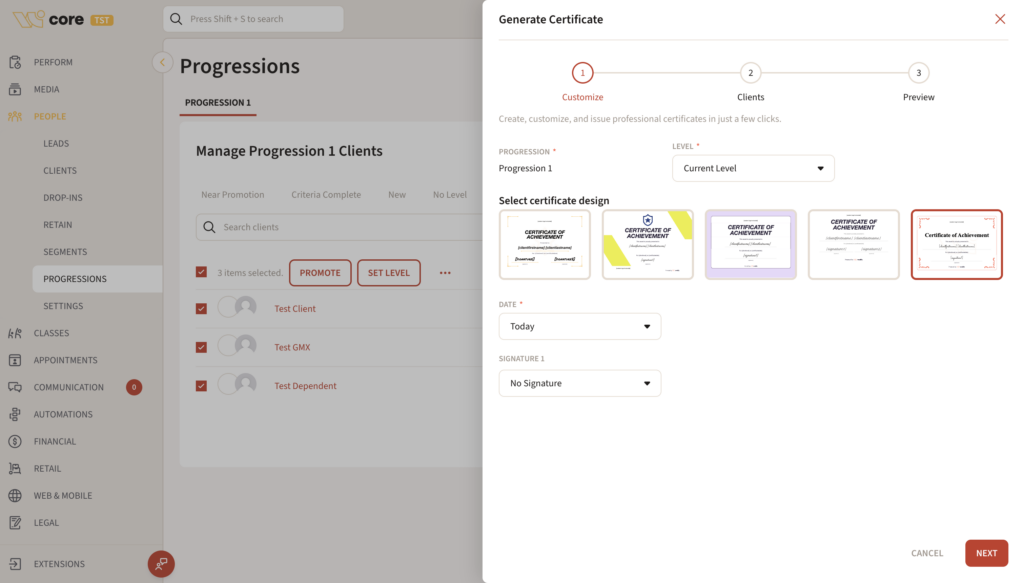
Wodify’s Progression Certificates were built specifically to help you become a legend in martial arts belt tracking.
Progression Certificates help you reward your students for their hard work. You can use our five pre-built templates, or customize yours with your school’s own branding. Then deliver them to your clients over email, or print and sign them to hand out in-person.
There are a few reasons why this matters for improving academy retention. First, students who receive a certificate now have a tangible marker of success, which can be powerful for motivation. Second, it shows that your school takes development and progress seriously. For growing a kids’ martial arts program specifically, that kind of recognition is a meaningful part of why families stay enrolled.
Lastly, from an operations standpoint, you’re saving time on things that would’ve traditionally taken up hours. Without having to track the milestones manually and design something in Canva, let your software do the martial arts belt tracking work for you.
When done effectively, martial arts belt tracking is actually a solid retention system for your academy.
Even though students may leave for a variety of reasons, one of the most common is not seeing progress. It’s not that they’re frustrated or unhappy. Chances are, they actually love your school. But if they feel stuck, motivation and attendance suffer.
That’s why a visible, structured progression system is critical. When students can see exactly where they’re progressing or need improvement, or how close they are to their next milestone, they have a reason to keep showing up. The next belt becomes an “almost there” goal, not an abstract future event.
Here are three quick suggestions to use belt tracking to boost retention:
Running a successful academy involves the full experience, not just what happens on the mat. And martial arts belt tracking is a significant part of that experience. When done right, students will feel seen, acknowledged, and celebrated.
Getting it right doesn’t require a complicated system. Start by documenting your requirements and various programs. Then decide how promotions get triggered and align your staff with your process. Then find the right martial arts software to take the work off your plate.
Need help? We’ve helped hundreds of martial arts academies run smarter and grow faster. Book a demo with the Wodify team today to find out more!
Pro Tip: There are some simple ways to level up your sales process and get more students in your academy. Download the “Mat to Member Playbook” today!
Norem ipsum dolor sit amet, consectetur adipiscing elit. Etiam eu turpis molestie, dictum est a, mattis tellus.
Already know which provider you want to select?
Click “Sign up Now” to lock in your choice and pick your start date. It’s quick and easy!
Looking for a bit more information or guidance? Click “Talk to Us” to arrange a call with us. We’ll help you find the perfect program tailored to your needs.
Norem ipsum dolor sit amet, consectetur adipiscing elit. Etiam eu turpis molestie, dictum est a, mattis tellus.
Norem ipsum dolor sit amet, consectetur adipiscing elit. Etiam eu turpis molestie, dictum est a, mattis tellus. Sed dignissim, metus nec accumsan.
Norem ipsum dolor sit amet, consectetur adipiscing elit. Etiam eu turpis molestie, dictum est a, mattis tellus. Sed dignissim, metus nec accumsan.
We’ll let you try Wodify for yourself and get a feel for what it can do for your business. A Wodify rep — a real person — will walk you through every feature.




"Wodify transformed how we run the gym. I now have more time to focus on growing my business and helping members thrive."Dana Bradley, Owner of Westside Fitness
Click “Talk to Us” to arrange a call so we can discuss the flexible access options that best fit your facility.
Click “Book a Demo” to learn more about how Wodify can help your business grow.
Your branded app is one conversation away. Click “Talk to Us” and our team will walk you through everything you need to get started.
Click “Book a Demo” to learn more about how Wodify can help your business grow.